I finished writing this poem and now I want to fall asleep. How about you? Anyway, if you are conscious enough, I'd appreciate a follow, tip, or monthly pledge. You can also find my musings on my personal blog, Facebook, and Twitter.
Then circumference springs support reclined friends
Musing of sacred mysteries.
Soon we slumber under Perseus’s protection.
- ---
Under beams of immortal moon,
Westward of any plotted town,
Youth leaders guide my eyes
Through magnified lenses
Upon reflective rocks,
Cratered orbs, clouded globes,
Dusted iced rock ovals--
Mere mirrors of superior suns.
----
Under shroud of bluish black
Adjacent steepled spaces,
Sacred silence encompasses.
My gaze reaches Orion’s belt.
Unlike Orion who hunted beasts,
We’d hunted, nay gathered, ancestors home,
Mortals to achieve immortal mansions.
----
Like spilled milk across dark granite top,
Within wire perimeters,
Feet sink in the grass,
My finger aims to Polaris
Guiding my son's eyes above.
Two dippers stream celestial serene,
Intersect upon our axis.
----
Beneath sky's stalactites
Over suburban pentagonal homes
Lighted linear paths, darkened rectangle yards
My house obscured; no lights left on.
Two perched on back porch steps.
Warm wind brushes over our squared legs;
Two entwined hands triangulate.
As one outstretched grasp,
our corporeal compass circumscribes
Charted pinpoints, like glimmering glass fragments,
Pressed upon a mosaic map.
I capture the moments throughout my life where I have gazed at the stars and been infused with God's love. I refer to a sleepover, stargazing at a Young Women's activity, looking at Orion's belt after doing baptisms for the dead in the Monticello Latter-day Saint temple, and stargazing with my sons and my husband.
I hadn’t written poems for most of my high school senior year because I had been super busy. I studied poetic devices in greater depth in AP English literature and wanted to play with alliteration symbolizing wind. I envisioned a woman who asks the weeping willow tree about WW2 European battles. I wrote the poem "Weeping Willow" but hadn't illustrated anything until Spring 2021--a few willow branches with raindrops.
Further Inspiration
After two relatives passed away this summer, my brother wanted to create paintings about life and the afterlife to give to the children. My brother asked if I would do some of the artwork. Since I had been dabbling with coloring/drawing with markers for eight months, I thought I'd try my hand with markers. A mental vision of willow branches as a veil, rain as tears, and a rainbow of hope emerged from my earlier idea.
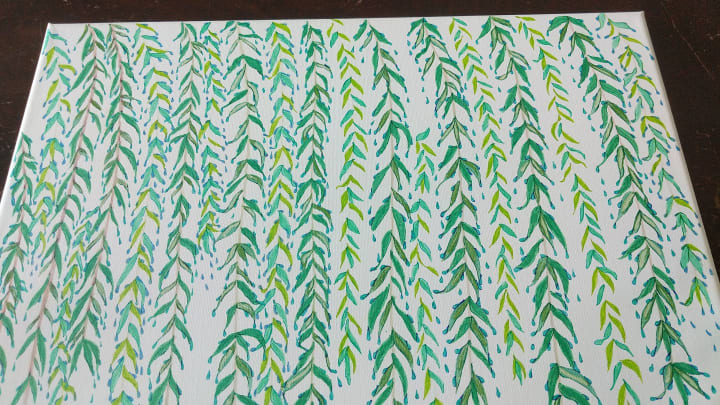
Drawing branches Photo by Author
The Branches and Rain
I started with some branches using Crayola's "Colors of the World" markers. On my first three branches, I alternated green leaves with a Sharpie marker and a Papermate marker. The Papermate green marker rubbed off on my right hand, so I kept wiping it off. I used a random brown marker to darken the connection of the leaves and the branch. It looked wrong, so I tried blending it with a light skin tone Crayola marker. The branches turned out thicker than I wanted, but it was now permanent. I removed the random marker from my art markers.
Using the light skin tone marker, I drew a line through the leaves too causing the Papermate marker ink to blend with the Crayola marker ink. I felt a little concerned. However, when I viewed the dried product the next morning, I liked the bleeding effect and the paler tone. For some of the leaves, I added green in again. That green turned out darker.
With each branch, I outlined the leaves then filled them in. I ensured each marker stroke followed the outline's direction. Next, I shaded with dark green lines. I outlined the raindrops then filled them in with ultra-fine point aquamarine or light blue markers. I first drew a circle of white as my highlight to draw around. About half the time, the white spot stayed. On the aquamarine drops, I shaded them with light blue. On the light blue drops, I shaded them with light gray. Next, I shaded all the raindrops with royal blue. Finally, I darkened the branch and drew a line through the middle of the leaves with a Color of the World marker.
Washing Off Marker
While drawing the final branches, my toddler squiggled near the upper right corner. The marker was washable, so I hoped a wet rag could take it off. It did! I wiped off other smudges too. However, this doesn't work on the Sharpie markers or regular paper that soaks in ink.
The Rainbow
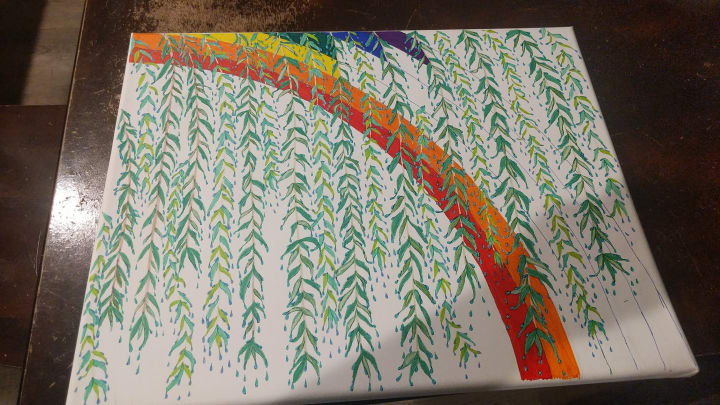
I felt nervous about drawing the rainbow arc because I had no circle big enough to trace the lines. My brother had shared with me how to draw circles when he showed me his first painting. He used a string with a pencil attached to the end. Hold the string still on one end while drawing the circumference. This video illustrates it in the last example, but I wouldn't use a pin.
Instead of a pin, my husband held the string on the bottom left corner while I drew the first arc. On the second arc, I noticed the arc had shifted. My husband said I needed to keep the pencil in the same position. I redrew the second arc an inch apart. I repeated the process solo adding an inch of string for the next arc. I felt so proud that I had drawn such a clean arc.
Filling in the rainbow, I had difficulty choosing hues because I only had bold hues in my fine point marker inventory. I would run out of ink using the muted ultra-fine point markers. I chose bold colors anyway. First, I traced the pencil line and branches with the ultra-fine markers in each color. Second, I filled in with the fine point markers while keeping my lines arched. Finally, I applied darker shades of green and blue to the leaves and raindrops.
The Background
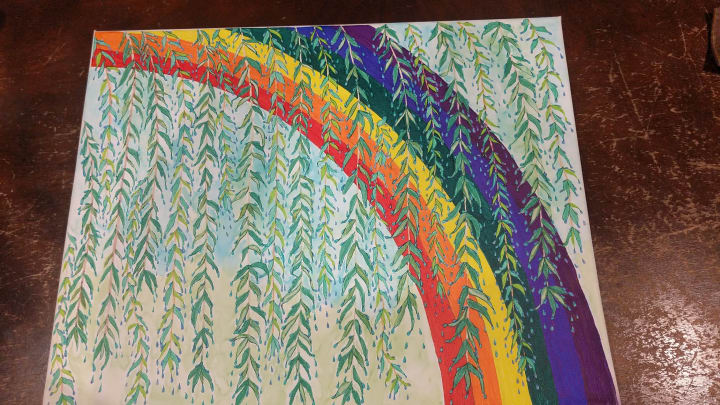
How would I fill such a large background space only using markers and not run out of ink? I pondered and concluded I could smudge the water-based markers. I bought small sponge paintbrushes at Hobby Lobby.
First, I squiggled blue or green between the leaves. Second, I dipped the sponge brush in water and squeezed out excess water. Third, I used the sponge to smudge the marker. Some of the leaf ink smudged too. Fourth, I patted the excess water off the canvas with a paper towel. Fifth, I rinsed out the brush between smudges.
Finally, I outlined the leaves and raindrops that faded into the background, especially the leaves that had bled. I kept thinking the art piece needed more, but I told myself it was time to be done. I let the canvas dry overnight and I felt pleased with the smudged background in the morning.
Still, the temptation loomed to shade more. But I let the urge go. The piece was good enough.
The Symbolism
We all have struggles when we can't see through the metaphorical veil of tears. But there is a promise, God's promise, at the end of the storm. A rainbow will appear to remind us of the promise of better days. We can have hope during our painful times. We can find the color amid the gray.
We are afraid of the COVID-19 pandemic affecting us or our
loved ones at this time.
The newspapers report daily counts of COVID-19 deaths.
It increases our anxiety. We also cannot connect in person with more than those
that we live with currently. We maintain six feet separation from others. As
our fear increases, we need ways to combat that fear.
Personally, I have found that counseling, writing, and
religious observance has eased my fears. I believe that my faith in God has
helped me the most through this time. Heavenly Father and Jesus Christ love us
and are aware of our pain.
My greatest fear, and any parent’s fear, is losing a child.
I almost lost my son a year ago when he accidentally strangled himself with a
jump rope. He was unresponsive and blue. My husband revived him, but then we
feared what bodily or brain damage he would have. My son fully recovered with
no damage except some ligature marks on his neck. I don’t believe they are even
visible now.
My fears continued as I struggled to let my sons play
outside. My husband and I had frequent night terrors of my son’s lifeless body.
Through counseling, prayer, and priesthood blessings, my fear has greatly
lessened. I still have some night terrors. I can handle letting my sons play in
the backyard. I remind myself that they most likely won’t die. My son’s
accident was a random accident.
I reminded myself that it matters more what God thinks of me
more than other people. People are flawed; our Heavenly Parents and Jesus
Christ are perfect.
“Therefore, hold on thy way, and the priesthood shall
remain with thee; for their bounds are set, they cannot pass. Thy days are
known, and thy years shall not be numbered less; therefore, fear
not what man can do, for God shall be with you forever and ever.”
Since I was ten years old, I have been writing stories and dreamed of being published. Many novelists have the same dream from a young age, so I am one of many. It is about finishing a work, yet I struggle to finish.
Today I am tired after substituting a kindergarten class, taking my son to the clinic, and making dinner. I want to write fiction, but that doesn’t come as easily to me. I have trained myself to write a blog post over the last six years. It is harder to get back into writing fiction seriously.
I have been too tired for sixteen years since leaving on my Latter-day Saint mission. During the mission, I only wrote letters. After I came home early, I reordered my life to cope with my new diagnosis of bipolar 2. I worked two jobs until marriage. Then I worked more, attended college, fell asleep after work, and had children. I felt tired for 9 years. After my third son, I managed to have some energy to blog and ghostwrite two novellas. Then I felt too tired during my fourth pregnancy. About two years later, I felt I could blog again. In the meantime, I wrote several chapters in several books. I made minute progress and then I lost interest.
Having bipolar 2, my brain is also wired at times. I have many shiny new ideas for novels (and blog posts) that I never finish. I start some novels but struggle to go beyond a week or month. I become bored with the project. In high school and college, I managed to write “novels” of 20,000 words. They were rough drafts that became second drafts. I sent these to publishers with no bites. I understand why I had no bites now. They were not detailed enough. As my creative writing teacher at BYU stated, the novels lacked immediacy. I had mostly dialogue, but no details to ground the reader in the setting or action.
The novels I wrote needed reworking and the plots have changed over time. I have my list of plot ideas for the novellas I wrote in high school and college. Many ideas will fall by the wayside. That’s the nature of the beast.
Currently, I have ideas for a humanoid species who have different powers, such as mind-reading, object-reading, lip-reading, mind control, and empath powers. They are in a hierarchy of who rules over another species. This idea came from the BLM riots. History could be rewritten according to the prejudices and enslaving different “readers.” So far, I have written the creation stories of the mind-readers and lip-readers.
In order to finish many of my partial drafts, I need to reacquaint myself with the characters, settings, and plots. That can take several days or weeks that I just don’t want to “waste” during the hour or so I have time each day. I also find that I want to write about issues currently troubling me. I need to itch that scratch, per se.
What I can finish easily are poems. When my mind catches onto an idea, I can usually write a poem within days. Albeit, they may be excellent poems or mediocre poems. I may rework them later. I know others who struggle writing poetry yet can write fiction quickly. I have that momentary excitement and hyperfocus that can channel writing poetry. Not so much with novels.
Editing is another aspect of my writing. I can catch some errors quickly, while others are not so obvious. Some words I misspell almost every time: piece, niece, opportunity, and so on. Yet I can spell most words with great ease. Grammarly has been very helpful with the self-editing process.
I wondered if I still had my editing prowess since I haven’t been a tutor for 17 years. Recently, a relative and friend asked me to proofread their writing. My skills came back. I recognized error patterns that I could point out and revising for a specific audience. My friend said I retained her writing style, which makes me very pleased. That is the goal of editing: to retain the writer’s style through editorial changes.
Now here I am writing another blog post about writing instead of writing fiction. I can manage some blog posts within 2–4 hours, which is why I usually devote my time to blog posts.
One day I will write fiction with ease again. When my children are older. When my youngest leaves the house. When I finish vacationing during retirement. Okay, maybe that time will never come unless I change my habits.
I remember my paternal grandmother on her birthday, 9/11, each year. She died six years before the 9/11 terrorist attack. My father thinks she would have been very upset knowing her birthday was on such a sad day. This year she would have turned 115. My maternal grandmother passed away last week at 90 years old. She witnessed almost a century of history — 89 elevenths of September. I remember 19 elevenths of September since 2001.
In August 2001, I started my freshman year at the junior college in my hometown. I lived at home and my parents drove me to campus. I stayed for classes and walked home afterward. About three weeks into my freshman year, the world changed.
Around 7:30 am MDT, my mom drove me to school in a red Ford Taurus when we heard the news on the radio of an attack. Something had happened, but I didn’t catch all of it. I attended my freshman writing course and the professor mentioned nothing about the news. Two days later, he apologized for not addressing the terrorist attacks, explaining he hadn’t yet heard the news that morning.
At home, I watched the news for many hours as I digested the information of attacks on the Twin Towers, Pentagon, and Flight 93. The image of the planes crashing into the Twin Towers seared into my memory.
On September 13, 2001, I wrote this in my journal:
It has only been two days since 9/11. Someone is laughing at their cruel joke I suppose. That of course, was the day when idiots hijacked four planes. The World Trade Center collapsing. Pentagon. There will be many words said and written about this terrorist attack. And I will say a few of them. So many lives have been affected (besides the thousands that are dead). Now they say New Yorkers are [more] considerate. They changed. Did it have to take that much to change people? I hope it is a permanent one. Petty stuff doesn’t matter.
I worked on a poem after the terrorist attacks. It seemed the best way for me to sort out the chaos I felt. Hopefully, it helps others sort out their chaotic feelings too when they read it.
My Mourning Prayer on 9/11
I don’t recall my morning prayer. Did I pray for world peace? The terrorists were seated by then, Maybe had control. How was the world to know? News flashed past my ears. Later, I understood the enormity; Then I mourned. Such evil! Such travesty!
The walls came tumbling down… In more than one way. Petty differences set aside Now in each other, we confide. As I lay me down, Oh God, I pray May this longer last And not fade in the past.
After 9/11, I felt a change in our country. We became kinder and more patriotic. People donated blood to help those in New York City and the Washington DC area. We donated money (some got stuck in charitable bureaucracies). Some negative things happened too. We had to navigate our negative feelings about Islam and Middle Easterners. We gave up some of our freedoms in exchange for safety. And wars lasted beyond their objective.
For these 19 years, some have speculated how we could have stopped the 9/11 terrorist attacks. I witnessed one solution when I toured the Shanghai Art Museum with fellow volunteer teachers in 2004. We gasped when we saw 9/11 footage playing on a stairway wall. The planes flew toward the World Trade Center, but then the planes bounced off the Twin Towers. I read the description for the video: The artist portrayed his little girl’s idea of planes bouncing off buildings. That was her solution to stop 9/11.
So may we have planes and buildings that bounce off each other. And may we have the resilience and courage to bounce back from defeat.
As a teenager, I often gazed at the moon and stars through my bedroom window. God’s creations bore witness of his love for me. I contemplated how I could personify this message in poetry.
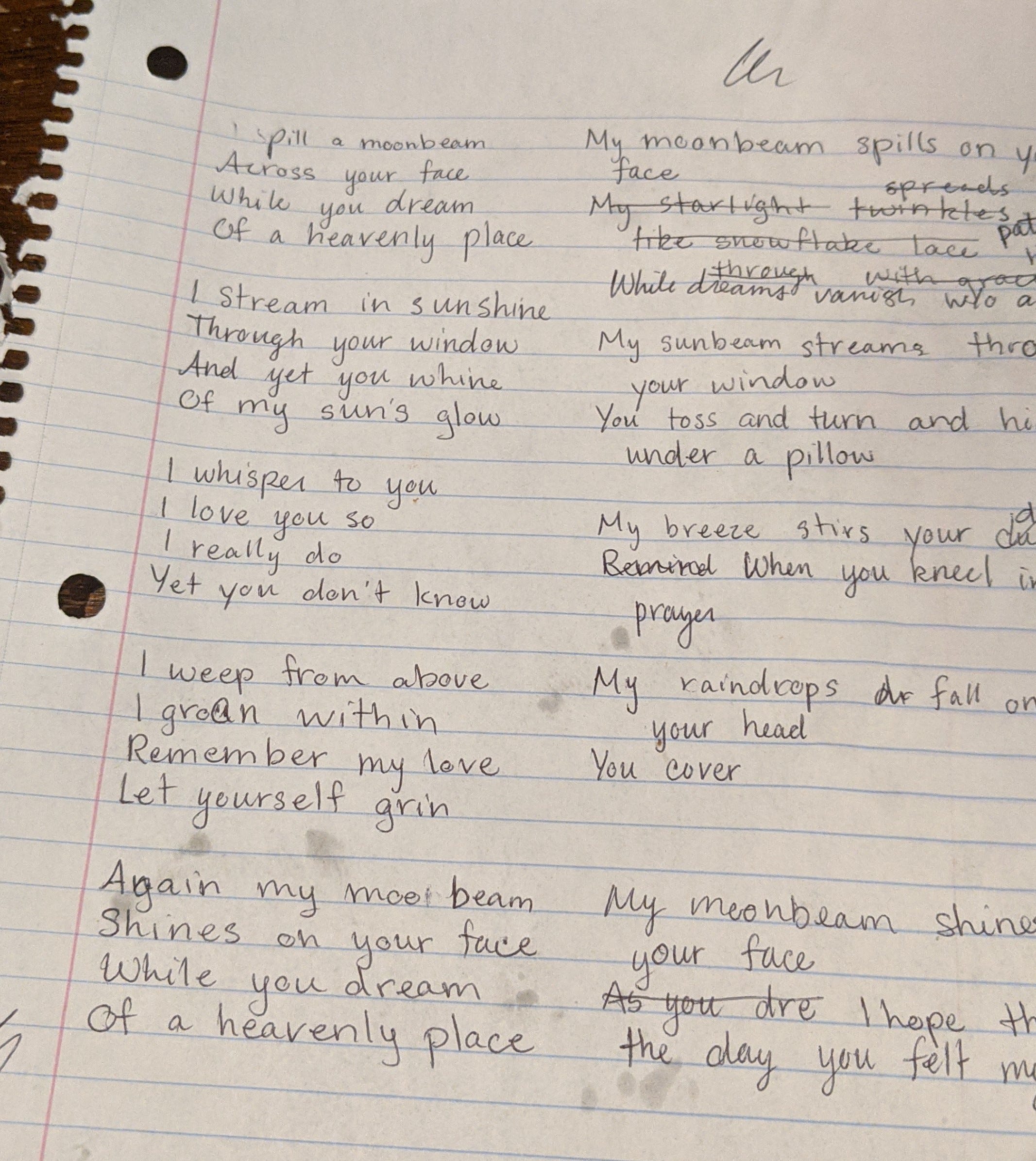
I wrote my first draft entitled “I spill a moonbeam” during my high school freshman or sophomore year. The words came as a song. Whenever I shared this poem, I sang it. I sang this poem to a friend during a sleepover. She complimented my singing voice, which I had never considered as beautiful, just off-key.
My first draft reads thus:
I spill a moonbeam Across your face While you do dream Of a heavn’ly place.
I stream in sunshine Through your window, And yet you whine Of my sun’s glow.
I whisper to you, “I love you so! I really do.” Yet you don’t know.
I weep from above. I groan within: “Remember my love! Let yourself grin.”
Again my moonbeam Shines on your face While you do dream Of a heavn’ly place.
I showed this poem to another friend. She noted that the “do” felt repetitive. She wondered why people added “did” and “do” to poetry. I figured the “do” belonged in the first stanza because it kept the rhythm. I didn’t remove it.
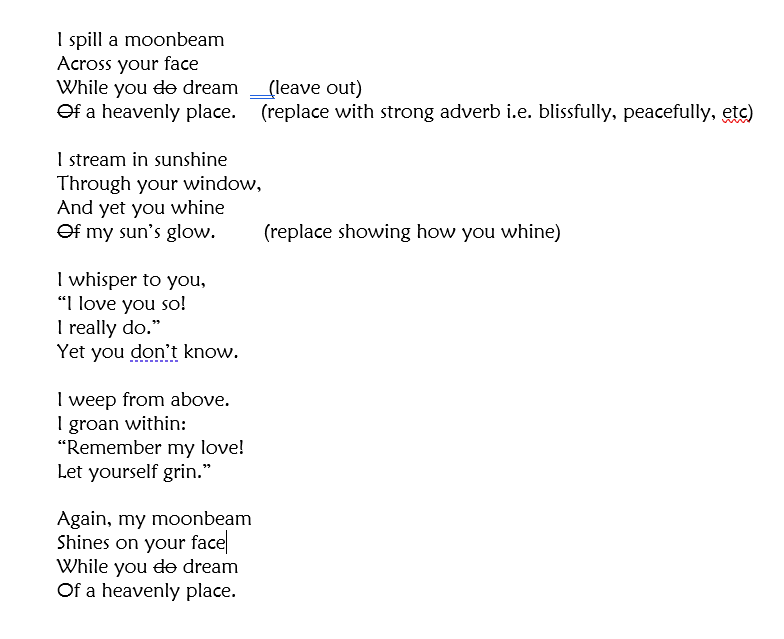
A few years ago, I compiled a nature booklet that I hoped to sell on Amazon. I asked a retired English teacher from my hometown to look it over. She suggested removing the “do.” Here are her suggestions:
Screenshot by Author
I finally gave up the “do” for the next beta reader. Here are her suggestions:
Screenshot by Author
This revision still lacked the poignancy I wanted, so my mind percolated on how to improve the poem for the last few years. Last month, I finally wrote a revision late at night.
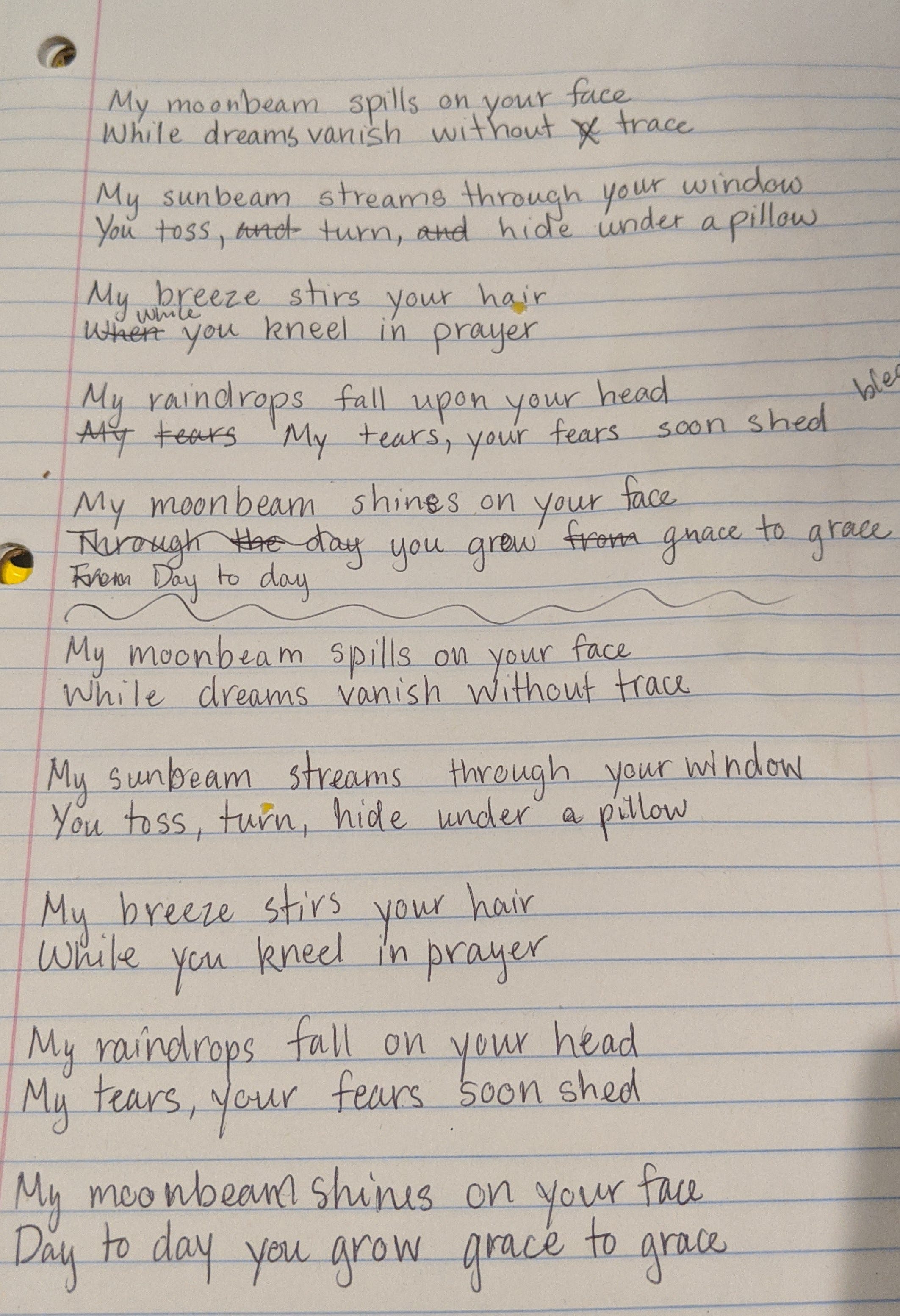
Here was my revision process:
Photo by Author
Photo by Author
Without further ado, here is the final revision of my poem:
My moonbeam shines on your face While dreams vanish without trace
My sunbeam streams through your window You toss, turn, and hide under a pillow
My breeze stirs your hair While you kneel in prayer
My raindrops fall on your head My tears, your fears soon shed
My moonbeam shines on your face Day to day, you grow grace to grace