September 03, 2020

My Moonbeam Spills on Your Face

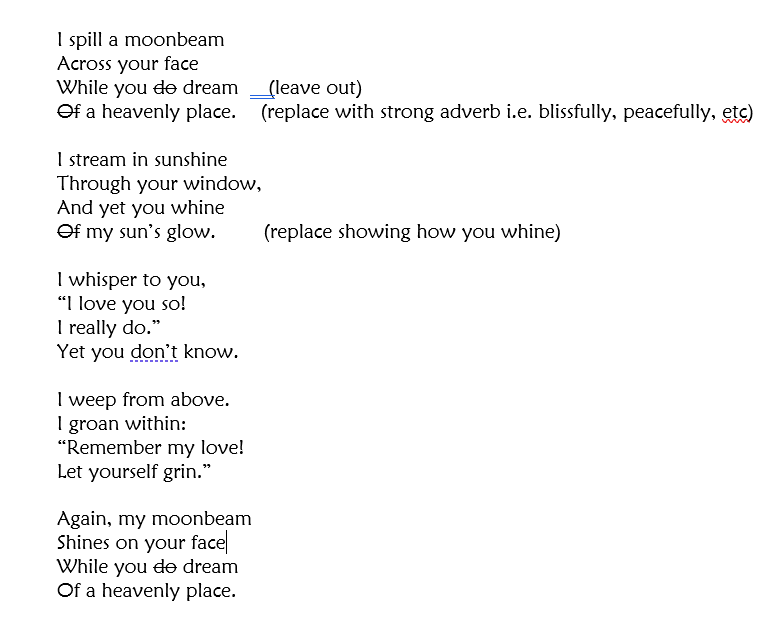
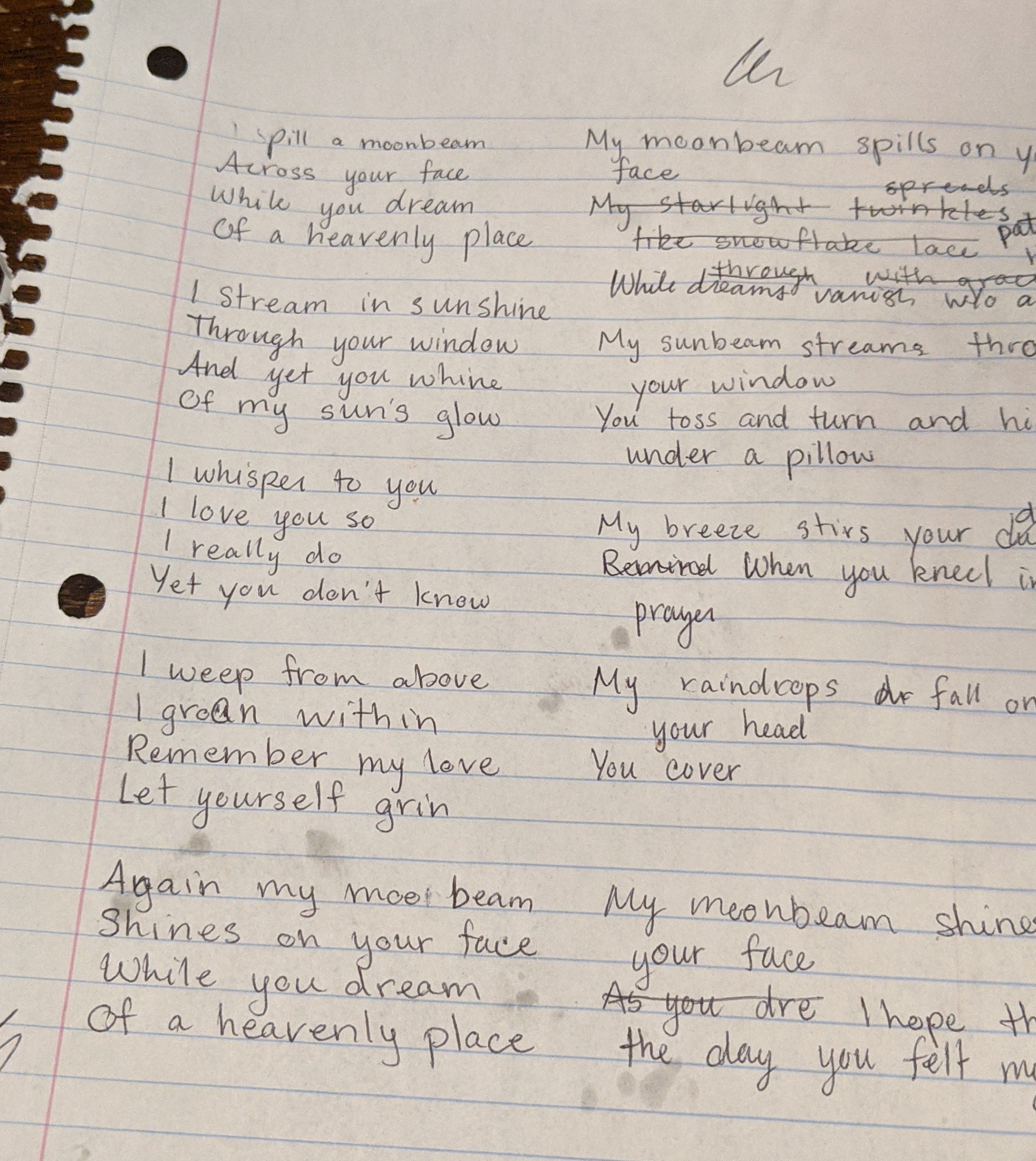
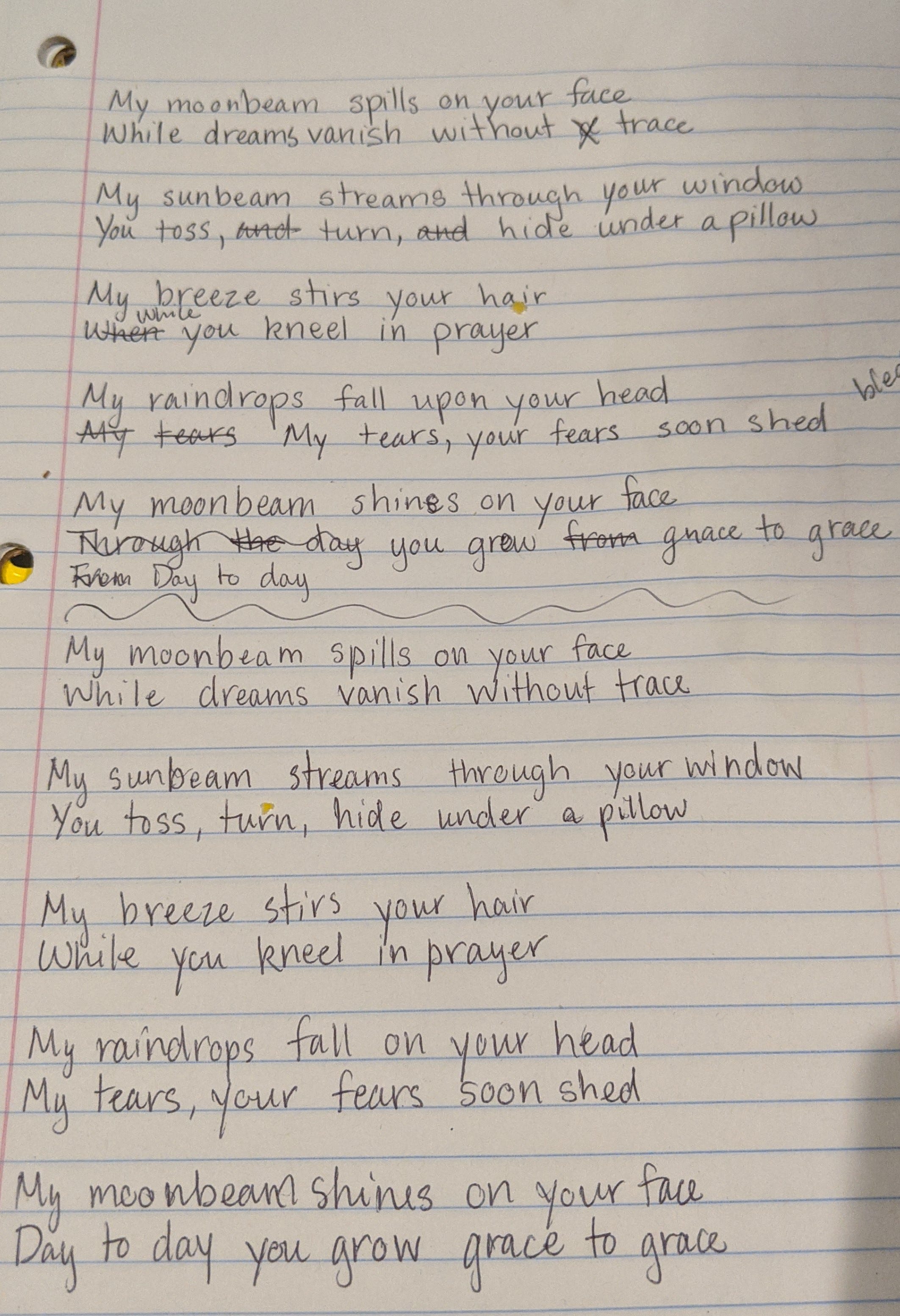
As a teenager, I often gazed at the moon and stars through my bedroom window. God’s creations bore witness of his love for me. I contemplated how I could personify this message in poetry.

Screenshot of comments
Screenshot by Author
Second poem with suggested edits screenshot
Screenshot by Author
Third revision
Photo by Author
Final revision
Photo by Author

August 20, 2020

My Son's Speech Therapy and School Mask Mandate Conundrum

As an infant and toddler, my youngest son had frequent ear infections. The infections were indicative of fluid retention in his middle ear. The fluid prevented his eardrums from vibrating properly, thus causing conductive hearing loss. The doctor placed ear tubes in his ears two years ago so his middle ear can drain since his Eustachian tubes weren’t draining properly.

My son’s expressive language is stuck in the babbling and one-word stage, which is the spoken language level of a one-year-old. He says a few words like tickle, no, ma, and da. Mostly, he babbles. Occasionally, his intonation sounds like a word or phrase. Overall, we have to repeat sounds many times before he imitates them. He responds better when he imitates his brothers or the sound is linked with an action.

His receptive language is much higher. He can point to objects or follow one-step commands. For example, when I say “Where’s the ball?” with a book, he will point to it. And he will throw trash away if I ask him to as a one-step command.

Because my son is stuck in the one-word/babbling stage, seeing is important to his language development.

What role does sight play in learning language?

From the moment children are born, they are imitating our facial expressions. Psychologists believe this imitation derives from our “mirror neurons.” One such imitation and expression is when an infant smiles around eight weeks old. They also imitate the manner of articulation from what they see and hear their parents say. The imitations carry through an infant’s cooing and babbling stages. Babies will take conversational turns of smiles, coos, gestures, babbling, and other actions. For example, if you stick your tongue out, a baby will copy that, but usually at a slower pace.

The School Mask Mandate

Ever since Utah Governor Gary Herbert ordered that all students should wear masks (or face shields), I have wondered how this would affect my toddler in special ed preschool and speech therapy. He would probably be covered under the disability category, but I didn’t know. I figured I could do a face shield for my son and the teacher would be wearing only a face shield. I discussed this with the preschool speech therapist when she visited for extended school year visits. She hoped that it would only be face shields.

On August 14, Gov. Herbert ordered that teachers must wear a mask with the face shield. All students must wear a mask unless they have a doctor sign a medical exemption form. Section (3)(e) of the mandate states a communication exemption:

an individual engaged in an activity where the ability to see the mouth is
essential for communication, including an individual who is deaf or hard of
hearing while communicating with others, an individual who is
communicating with an individual who is deaf or hard of hearing, or a
teachers-student dyad participating in speech therapy, in which case the
individual shall wear a face shield without a mask or use alternative
protection, including a plexiglass or similar barrier;

I tried to get some clarification from my son’s previous preschool teacher during our extended school year conversations about this. She stated students and teachers must wear masks from the last update. She didn’t seem to know anything about the exceptions for speech therapy. It seems there is a lack of communication about the exceptions.

Overall, I am very confused; some teachers are confused too. Because the rules change frequently, parents and teachers are both scrambling to figure this out. Preschool starts next week, so the kinks are yet to be determined.

Last week, I made five masks for each of my four sons to last a school week. I included my toddler because I don’t know exactly what is going on. Amid the confusion, my older children have adjusted to school with masks. Maybe my youngest will adjust well too.

On Monday, I read that deaf BYU students were considering clear face masks for themselves and their interpreters. Some read lips and also want to see the facial cues in ASL. I had an epiphany that they would work well for my son and his teacher.

I asked my son’s new preschool teacher if she would wear a clear mask. She said she’d try it out. I will be purchasing one for her most likely. This will all cost more money, but I don’t know what to do. My son needs to see the teacher’s mouth in order to imitate speech sounds better. I believe he could copy some sounds, but not as accurately.

What can I learn from blind babies’ language development?

While writing this post, I realized that sight is not absolutely critical to learning language. For example, blind babies learn how to talk. I wondered how they learn to communicate. I found some answers on Family Connect. A blind baby learns more through touch and sound. An adult can put a baby's hands on their lips or hands.

So masks will not stop my son from learning to talk but may make the process longer.

However, children are very resilient. Their plastic neurons forge new connections to adapt to the different learning circumstances.

This school year may be different, but children will still learn.

A Year Later

I witnessed how the mask exemption at my third son’s grade school worked when I substituted his special education class. The speech therapist, special education staff, and students wore face shields during therapy sessions. Otherwise, they wore masks. The face shield exception only applied when my third son attended therapy. My son could take off the face mask during recess, P.E., and lunch. I noticed he pulled it down to suck his thumb occasionally. For more details on masks and my substitute experience go here.

My third son also had frequent ear infections. After ear tube placement, his language returned to normal except for his “s/sh”. He first backed his tongue placement as an “h” and glottal stop. Now his “s” usually sounds like “s” or “sh”. Over the last year, my third son’s reading level improved one grade level (he is still one level behind). His “s” improved a significant percentage, mostly in the initial and final syllable slots. His “s” blends are still lagging behind.

I am unsure how the staff enforced the mask mandate in my youngest son’s preschool. I sent a mask in his backpack, usually a mask with a clear center. I offered the teacher adult masks with a clear plastic middle, which she accepted. I don’t know if she ever wore it. Those masks were harder to breathe and talk through when I wore one once substituting. I believe the speech therapist used a face shield during therapy. I don’t know what my son wore. I suspect he rarely wore the mask correctly or at all considering my fourth son usually wore it under his chin, over his eyes, or not at all during church service.

Over the last year, he increased his word count with banana ‘nana’, shoe, water, and possibly a few others. The speech therapist implemented a communication board, which he uses at home for more, want, and help. He signed more before the pandemic, then stopped. He increased his sign usage this year to more, help, stop, go, all done, and water. His “t” no longer sounds like “d”.

2021 School Year Mask Recommendations

This school year, Utah rescinded the school mask mandate because the legislature restricted the emergency powers of the governor and health departments. Grand County reimplemented the mandate because their county government approved it for 30 days. The Salt Lake County Council overturned Salt Lake County’s health department mask mandate for children under 12. Mayor Erin Mendenhall is looking to overturn that decision. President Biden may challenge Utah’s and other states’ lack of a school mask mandate. All Utah mandates still have the same exceptions as before. Other schools across the nation vary with their mask mandates despite the CDC’s school mask recommendations. 

The American Academy of Pediatrics states:

“While this is a natural concern, there is no evidence that use of face masks prevents or delays speech and language development.”

Their article addresses parents’ concerns, contains tips to work around the mask, and work with speech therapists.

On the other hand, the UK, Sweden, and Holland largely do not require masks for children 12 and under. UNICEF recommends children under 5 not wear masks, and children 5–11 only wear them under certain circumstances. The website states for 5–11:

“You should also consider the potential impact that wearing a mask could have on your individual child’s learning and psychosocial development. Decide this in consultation with your child’s teachers and/or medical providers.”

Obviously, mask recommendations vary for children and those with speech delays. 

With my background in linguistics and my parental intuition, I believe children learn language better without masks. But I know they can learn in masked settings too. For now, I send my children to school without masks because I “consider the potential impact that wearing a mask could have on [my]individual child’s learning and psychosocial development.” If a mask mandate comes, I will mask my children.

This I know, children are resilient.

August 12, 2020

Medications that Interfere with Bipolar 2


Via Public Domain Photos

I have learned over the past 16 years what medications, beverage additives, and herbs tend to exacerbate my bipolar symptoms. Some of these through talking with doctors and others through trial and error, unfortunately. I share my experience hoping that others with bipolar, and their loved ones, can work with their doctors to discuss options when taking similar medications. So take this with a grain of salt. It is for informational purposes. Your body, or your loved one’s body, may react differently.

St. John’s Wort

My senior year of high school, I experienced a depressive episode. My mom talked with me and we discussed that I probably had depression. We weren’t sure of the severity yet. I started taking St. John’s Wart at the end of my senior year and through my freshman year at a junior college. My depression went away during that time, but I over-involved myself in college and activities. I stayed up late on weekends and was a bit louder than my reserved self. I worked a part-time job, attended my religious organization’s Institute and choir all while taking 16 credits fall semester, 21.5 college credits winter semester, and then 18.5 college credits the summer semester. I was hypomanic for a year, which was probably exacerbated by St. John’s Wort. I had small crashes where I quit my class and quit my job during the summer semester.

I stopped taking St. John’s Wart when I left for Brigham Young University and I fell into a depressive episode several months later. This time I sought for help only for my depression.

St. John’s Wort can cause mania and hypomania in bipolar patients. It is also not in normal dosages that can be relied on from company to company. St. John’s Wort is still a drug like any other pharmaceutical. If you have any mood symptoms, I would consult with a psychiatrist or a doctor and therapist combo.

Antidepressants Alone

At BYU, I related to the regular doctor that I was depressed and having suicidal ideation. The doctor prescribed an antidepressant and I went home to the APRN with that diagnosis. He kept prescribing an antidepressant. I felt happy with no complaints. My previous energy from a year ago returned. But the hypomania wouldn’t last forever.

I burned out serving a mission for the Church of Jesus Christ of Latter-day Saints. I felt the beginning when I was in a strict schedule at the Missionary Training Center, but the “mission field” in San Antonio felt more restrictive. I was tired in the morning and awake at night. I cycled through emotions quickly. I became suicidal the last two days. Then I went to the mission home. The mission psychiatry department asked if I wanted to stay or go home. I chose to go home.

My mission companion suggested I had bipolar. I considered that and talked it over with my mom and dad. My mom and I were really convinced as we looked at symptoms online. We then met with the APRN. He was convinced when I had displayed “psychobabble.” I talked hurriedly and had to make my point.

Antidepressants alone act similar to St. John’s Wort where they can cause mania or hypomania. Bipolar patients need a mood stabilizer in addition to an antidepressant to counteract this problem. Occasionally, a doctor will only have a bipolar person on an antidepressant if they are experiencing only depression and being closely monitored.

Caffeine

When I drink caffeinated soda or have dark chocolate and chocolate in the late afternoon or evening, it can keep me up at night. I feel restless and have racing thoughts for several hours. Some nights I am still wide awake late in the evening. I review what I ate: usually I had caffeine in some form. I especially forget about the effect of chocolate, especially dark chocolate. Basically, caffeine can cause a brief hypomanic episode in bipolar patients.

Caffeine comes in so many forms, sometimes it is hard to know if I had caffeine. For example, I found little treats when my family was briefly going to the food pantry that tasted like lemons. The gummy boasted it contained yerba mate. I was suspicious it might cause problems, but I tried it anyway. Well, I couldn’t fall asleep that night. I had racing thoughts. I searched for yerba mate online, and sure enough, it has lots of caffeine. It is the same mate that citizens in several South American countries drink. My husband saw many Uruguayans drink mate (with lots of sugar) on his LDS mission in Uruguay.

I have learned I need to look at labels carefully for caffeine. Sodas are especially tricky to know about. I avoid dark chocolate now because it has more caffeine than milk chocolate. Overall, I only consume caffeinated beverages early in the day, unless I need to stay awake driving.

Coffee and some teas contain caffeine, but I avoid those for religious and health reasons.

Sudafed (Pseudophedrine)

I was always congested as a child. When I had strep throat in seventh grade, my family doctor prescribed Claritin-D. We figured I had allergies. I took it in the morning and I could finally breathe. I had fewer colds and only had occasional sinus infections. After worse congestion during my third pregnancy, I started taking Mucinex-D. Six months after I delivered my baby, I had an allergy test: I was allergic to nothing. So they looked at my nose. I had large turbinates and a Haller cell, an extra sinus cavity. I had surgery and could breathe again without any decongestant. Occasionally, I still get sinus infections. During those times, I tried Mucinex-D and Sudafed. Sometimes I took them at night. And I couldn’t fall asleep for hours.

I discovered that pseudophedrine is a stimulant similar to caffeine. It can cause hypomania in bipolar patients. I have learned that I can only take it in the morning. I have switched to phenylephrine as a decongestant. It isn’t as effective, but it helps. Nasal irrigators or netty pots help the most.

Prescription Steroids

I had a severe sinus infection and my ENT prescribed steroids to reduce the inflammation in my nasal cavities. I could breathe within hours. But I went into hypomanic episode. I wasn’t sure if it was related to the steroid, but I learned that it was.

A few years ago, I had another severe sinus infection, but my throat constricted to the point I struggled to breathe through my mouth. I went to my family doctor for relief. We debated over using a steroid because of the possibility of hypomania. I took the steroid for one or two days just so I could breathe. I felt so much relief, but I was wired until six in the morning. I stopped taking it the next day. I followed my doctor’s other advice to take 800 mg of ibuprofen. The ibuprofen reduced the inflammation so I could breathe better. But steroids are the most effective. If only there were no side effects.

Overall, I have learned that Mucinex, ibuprofen, phenylephrine, and nasal rinses combat my sinus infections without causing hypomania.

My relative with Multiple Sclerosis takes steroids and she has remained fairly stable. So there is a balance that people with bipolar can find between prescription steroids and bipolar medications.

Hormonal birth control

After my fourth baby, I bled for five months. I was baffled by this. I had an IUD placed when I was still bleeding. I figured it was just my period. The bleeding continued. My doctor prescribed a birth control pill in an effort to keep in the IUD. The bleeding lessened. However, I felt suicidal and depressed almost every day on it. I tried for two weeks, but it was too much. I believe we tried another form of birth control pill. I had an x-ray or ultrasound that showed no afterbirth remained in my uterus. Finally, my doctor referred me to a gynecologist. The gynecologist noted I had a thick endometrium. We settled on a D & C, which stopped the bleeding. The gynecologist suggested higher doses of hormonal birth control. I refused since a low dose already caused so much emotional havoc.

I had the birth control patch for the first nine months of our marriage. I figured that it didn’t affect my moods, but that other circumstances caused my problems. After all my bleeding, I wondered if the patch had exacerbated my symptoms.

I know that my body does better with only low levels of progesterone (like in Mirena). I am never going to use hormonal birth control again. I will stick with an IUD. However, my relative doesn’t have issues with her birth control, so who knows.

Overall, any female with bipolar needs to consult carefully with a gynecologist and psychiatrist on the best birth control method.

Conclusion

Different medications and substances can interfere with bipolar. I have learned through trial and error what works for me. Sometimes, I have had to find alternative ways to deal with frequent congestion, menstrual bleeding, and birth control. I am glad that my doctors have worked with me to resolve any mood disturbances. So much is observation. What works for one bipolar person may not work for another. But if any of my experiences help other people with bipolar, I am glad to share.


July 30, 2020

Anger as a Secondary Emotion to Fear

On Monday night, my husband, boys, and I were ordering snow cones on Main Street when my youngest son darted into the street. Time froze. I could only yell, “Damn you, kid.” My husband rushed into the street and grabbed our son. Our son squirmed in my husband’s arms for the next half-hour while we ate our snow cones.

I wondered why I would swear at my child when he was in danger. What I said wouldn’t do any good. What motivated my cursing my child? I know I had the freeze reaction while my husband had the fight reaction. I was afraid for my son’s life, yet I felt no control. My PTSD from my third son’s accident reared its ugly head when my youngest was in mortal danger. I believe my mind knew that my husband would grab my son, as my husband had saved my third son last year.

In recent online conversations, I have read how anger is a secondary emotion. I realized that my curse came from the primary emotion of fear (and love). I was angry with my son, but truly I was afraid to lose my son. I love him so much I don’t want to lose him. But I know life can be cruel at times. I thank God that this time my son survived unscathed.

My counselor and I discuss my third son’s accident as I am sorting through that trauma. My counselor talks about how rape survivors will blame themselves for not fighting against their attacker, but their bodies freeze just to survive the ordeal. Their reactions kept them alive and were necessary. Many reactions are simply to survive the ordeal.

I understand that my fear manifested in anger toward my son. I cursed him to cope with that fear. I can understand what I did was inappropriate. For that, I need to let my executive brain and my lizard brain work through the problem. I wonder if I can train myself to have a healthier reaction. Whatever happens, my body is going for survival of my offspring.

One time when a deputy sheriff pulled me over, he said something about making sure his kids/my kids wear the “damn seatbelt.” His statement was intimidating and inappropriate. But I understand where his anger comes from. He has seen unbuckled children die in accidents. He loves those he serves, though it may come out in the wrong way.

With the threat of COVID-19, some are letting their fear and anger overrule love. For example, a woman in a Gainesville, GA Walmart told an unmasked woman and her children, “I hope you all die because you’re going to kill me and my husband.” She was afraid for her life and her husband’s life. Her primary motivation of loving herself and her husband is a good thing. It’s letting the fear overwhelm her into attacking others that is wrong. A better reaction would be to politely ask people to wear a mask and educate others on the risks. Then let people decide for themselves.

How can we let love guide our actions first instead of anger? It takes a lot of practice and soul searching. We need to accept our fear and see how it can positively motivate us along with love. For example, we can encourage others to make wise choices, but not attack them in any form. We need to apologize when we hurt others. We need to forgive ourselves and others.

We need to breathe. Just breathe.


July 08, 2020

See the Whole Person: both Good and Bad

During my high school chemistry class, I thought I had a perfectly funny comeback in my head. My guy friends would sometimes joke, “Die!” when playing war or video games. Thus, I felt it was okay to blurt out, “I hope you die!” to a guy friend. The whole class of six people froze. Stunned, the teacher told me not to say that. Most were flabbergasted because that didn’t fit my character at all. I fumbled an apology with a strange explanation. They ignored me for the rest of class. The next day everyone talked to me like normal. They had forgiven me for my stupidity.

Via Wikipedia
Five years later, I read Orson Scott Card’s book,  and one lesson stuck with me: People have a mix of good and bad. Andrew “Ender” Wiggins in  destroyed the hostile aliens because he empathized with them. In Speaker of the Dead, Andrew Wiggins shared the good and bad qualities of the hostile aliens, which opened the eyes of the public years later. His new mission changed to sharing deceased persons’ narratives of their good and bad points.

Like Ender, we understand people better when we empathize with them. We recognize the good and bad actions and personality traits they have. We understand their motivations for their actions. Whether or not we agree with those actions, we understand why people act as they do.

In our current day, we need to see people from the past and present as an entire person before “canceling” them. We need to put their words and actions into context before making a final judgment. In the meantime, we can set temporary boundaries around inappropriate words and actions. For example, my chemistry teacher corrected me and my classmates looked at me strange and ignored me for a day. They saw I recognized my error and we all moved on.

Thus, it behooves me to forgive others their stupidity as I have been forgiven of my stupidity.

We have all made mistakes, or sinned terribly, but most of us have learned from those mistakes and sins. Look at how the person is acting now. Has the person apologized? Has the person deleted those awful words? Have they made appropriate compensations?

Instead of “canceling” a person, how can we encourage a person to change?

Overall, we need more positivity and love in our world to change lives for the better.

July 01, 2020

How Do I Use Thee, Mask?

How do I use thee? Let me count the ways.
I use thee to the depth and breadth and height
My face can reach, when breathing out of sight 
When I cannot maintain a six-foot space. 
I use thee to the level of every day's
Most germy need, by sun and moonlit night.
I use thee freely, as men strive to fight; 
I use thee purely, as eyeglasses haze. 
I use thee with the passion put to use 
In my relief, and with my doctor's faith. 
I use thee with a zeal I seemed to lose 
With my last fears. I use thee with the breath, 
Coughs, sneezes, of all my life; and, if law choose, 
I shall use thee even after death.


Parody of Elizabeth Barrett Browning's Sonnet "How do I love thee?"


June 24, 2020

Voting Responsibly Improves Our Nation

Via Public Domain Photos

The 2020 Presidential election yielded so much chaos partially because the last 21 years of elections are often split almost 50/50. Only local elections take place this year, but those are the elections that affect us the most. The US Congress and Senate races start next year. We can have a greater say by voting in our state primaries too.

In June 2020, I contemplated ideas on what I feel would improve police and race relations. On Facebook, I wrote a post to my friends and family about my thoughts. A police spouse mentioned that if we don’t like how police operate, then we need to change the laws.

Her comment and other memes, articles, and social media posts have stewed in my head. I really thought about changing our laws to prevent police brutality and improve race relations. We are a democratic republic, so we have more control over our laws than other forms of government. How we vote determines how much power the government and law enforcement agencies have. Some states are already making changes to reduce police brutality, while some cities have gone to the extreme of defunding police. The pendulum has swung back where many cities are trying to rehire police after record crime rates in 2020–2021.

Since 9/11, US citizens have surrendered some of their freedoms in the name of safety. We have let the fear of death overcome our reasoning. Exchanging some freedoms for security has given an illusion of safety, but created other problems. We have less speech, less privacy, lack of due process, more invasive search and seizures, and so on. In this process, we have allowed law enforcement agencies greater power. If we want our freedoms and power back, we need to value freedom more than safety and our physical lives.

Be a Good Person

We complain about our dysfunctional politicians and law enforcement and despair about how it won’t change. However, we voted in these politicians who shaped law enforcement. Our values are reflected in who we voted for. Sometimes we make compromises in voting, but we can work to make a better voting process.

First, we need to be good citizens. When we strive to be civil and loving toward one another, we tend to police ourselves. Thus, reducing the need for police. We need to respect each others’ agency. Some of us fall into the desire to control the other side or shut down speech through shaming and name-calling.

The US needs an honest and open dialogue to improve our nation. We need to respect each other, though we may disagree. All speech needs to be allowed; shutting down any speech hurts the process. Even bad speech produces more speech. Allowing open dialogue creates a marketplace of ideas. When we have multiple ideas, we have more options to solve problems.

Just Vote

During the 2016 presidential election, only 55% of registered voters voted in the United States. This was the lowest turnout in 20 years. That means 45% of the country didn’t vote for President. What if the other 45% had voted? What would be the difference then? Statistically, it would probably be the same, but we will never know. More citizens got the memo for the 2020 election which had a record voter turnout of 67%.

People have marched, fought, or died to have the right to vote. Why should we take that for granted?

Research Candidates

Sometimes US citizens are lazy voters. We only vote based on name recognition or party lines. We don’t research candidates to know what they believe personally. Then we are surprised when politicians betray our expectations. Like how Biden flubbed the Afghanistan troop withdrawal.

I find it sad that we feel like we have to vote for a certain candidate because of the political party they represent. We vote for a party, and not for the individual’s merits. The reasoning is to have a voting bloc in the legislature. But the party candidate can sometimes be scum. Our attitude of distrusting politicians derives partly from voting for dishonest candidates simply because they boost party numbers.

We need to vote for the individual. This way we vote FOR someone. If people voted for the individual, I believe we would trust our politicians more. Perhaps we’d elect better people.

A candidate that fits your political position may be in a different party or an Independent. Research your options.

Ranked-Choice Voting

Much of the disillusionment of voting is because we don’t feel that our vote really matters. It was disheartening when the 2020 major-party Presidential candidates represent the fringes of the party and not the mainstream of the parties. This is how it felt with the 2016 election too. We didn’t have people who really represented America. Many settled for the lesser of two evils, as so many of my friends and family mourned in 2016 and 2020.

But why do we have to settle for our vote? We aren’t limited to only two parties or even any party. If people really voted for who they wanted, I believe our elections would be different.

Our current voting system is all-or-nothing, but ranked-choice voting is gaining momentum. Ranked-choice allows for the voter to list their choices by first, second, third, etc. Whatever candidate has the most overall support wins. Ballotpedia explains ranked-choice voting much better than I can, so follow the link for more information. This system makes voting for a third party more effective.

Local Elections

Many times we feel that we only need participate in the national elections. They feel more important, but it is our city, county, and state elections that have more impact on our daily lives. We need a high turnout for those to make a real difference.

The law enforcement agencies we usually interact with are local police. This is where we gain most of our impressions of police outside of the news. Who we choose for mayor, city council, county sheriff, county officials, and so on have direct relationships with our law enforcement. They are the ones passing local ordinances and doing the funding, training, hiring, and firing of police officers.

Vote in the Primaries

Utah leans more Republican than Democrat outside of Salt Lake City and Park City, thus the Republican primaries usually determine who will win Utah elections. I know several liberal Utahns who are registered Republicans for this reason. So vote in primary elections so the process involves more than one wing of a party.

Nix Party Affiliation for Local Elected Positions

In 2014, several bills circulated in Utah Congress to allow state and local school board candidates to be affiliated with political parties. Some Utahns fought this politicization among the State Board of Education because it would create divisions in the Board. We needed individuals who value education more than party platforms.

I disagree with political affiliation in local elections because the populace can get to know candidates through local events. Many citizens already know or know of the local candidates. Overall, citizens don’t need the shorthand of political party affiliation to know their local candidates. Besides, it can divide the community.

Split Electoral College Votes

To truly make that change for who we feel would best represent us, we need to vote. It seems like a long shot sometimes, but every vote counts. Only in the Presidential election do votes not have as much power. We can make changes with our state laws to increase the power of the vote with the electoral college. For example, Nebraska and Maine allow their electoral votes to be split among candidates. This allows for a better representation of the minority. This way the political minority would feel more emboldened to vote in the Presidential election.

I disagree with abolishing the electoral college for three reasons. First, the US is a representative democracy. Second, smaller states, and more rural areas, retain more of their representation with this system. Third, Alexander Hamilton argued in Federalist Paper №68 the electoral college will yield a more “successful” Presidential candidate.

The process of election affords a moral certainty, that the office of President will never fall to the lot of any man who is not in an eminent degree endowed with the requisite qualifications. Talents for low intrigue, and the little arts of popularity, may alone suffice to elevate a man to the first honors in a single State; but it will require other talents, and a different kind of merit, to establish him in the esteem and confidence of the whole Union, or of so considerable a portion of it as would be necessary to make him a successful candidate for the distinguished office of President of the United States.

-Alexander Hamilton, Federalist Paper №68

Prevent Gerrymandering

Republicans and Democrats are guilty of splitting their congressional districts to represent one side or the other. These unfair boundaries undermine our democratic republic. As a result, political minorities feel disenfranchised by this manipulation.

In Utah, the congressional districts carve up the Democratic base of Salt Lake County. Democrats in Salt Lake County feel disenfranchised voting in Utah, as one relative related. Thus, we have weird geometrical shapes, especially the Congressional Fourth district where I live. It covers part of Salt Lake, Utah, and Juab counties. This has created animosity within the district where it is about half Republican and half Democrat. For example, the 2018 election had increased animosity in ads between Mia Love and Ben McAdams. The animosity continued with the 2020 race between Burgess Owens and Ben McAdams.

After the 2020 census, Utah is redrawing the district maps with voter input. A board is exploring the ideas and will make a final decision soon. Hopefully, this nonpartisan committee will yield fairer boundaries.

Nix the Idea of Supporting a Party Because of Race

We have this notion that all Blacks and POC are Democrats and all White Anglo-Saxon Protestants (WASPs) are Republicans. This simply isn’t true. Besides, it is prejudiced to say a certain race should be connected to a certain party. It may be true for a majority, but not ALL.

We see this symptom of prejudicial thinking in Joe Biden. In a video chat with Charlemagne Tha God, Biden stated, “If you have a problem figuring out whether you’re for me or Trump, then you ain’t black.”

This demonstrates a prejudicial and patronizing attitude toward Blacks. Treating Blacks like they are too dumb to vote independently and critically smacks of benign bigotry. Each Black person has individual opinions.

On the flip side, Republicans sometimes patronize White Evangelicals. Some candidates will espouse socially conservative positions though they themselves don’t believe in it.

Overall, a party that expects you to be their bread and butter vote based on a stereotype is highly prejudicial. The parties put less effort into addressing problems critically that affect that demographic and all Americans.

Avoid All-or-Nothing Voting Options

Some politicians promote all mail-in ballots or all in-person voting. Precincts and counties find it easier to stick with one method, but that disenfranchises voters with only one option.

In the 2018 election, Utah County initiated mail-in ballots being sent to everyone. As a result, they chose to have fewer ballot stations and ballot boxes. But some people and newly registered voters didn’t receive a mail-in ballot. Others waited to vote on Election Day. Many Utah County citizens stood in line for hours to vote when it usually takes less than an hour to vote on Election Day. As a result, former Governor Gary Herbert chided Utah County for the fiasco. The voting process in Utah County flowed more smoothly in 2020.

All in-person voting disenfranchises college students, missionaries, and military personnel. People who are temporarily away from their homes don’t have the opportunity to vote if in-person is the only option. Besides, mail-in ballots streamline the voting process. This requires fewer volunteers, time, and energy. In 2016, San Juan County saw an increase in absentee voting when they implemented mail-in ballots.

But mail-in voting disenfranchises voters who don’t have reliable postal service or are homeless. For example, San Juan County faced problems with voting on the Navajo reservation when they switched to mail-in ballots in 2016. Many Navajos in the Navajo Nation don’t have normal addresses, thus making mail-in ballots less viable. Some on the Navajo reservation would have to drive one to three hours to vote in the county seat, Monticello, Utah. San Juan County officials belatedly opened voting stations on the reservation. This relieved the problem some.

San Juan County officials have faced lawsuits and redistricting from the 2016 election. Some say the redistricting was unfair to Blanding residents, while others say it was fairer to Navajo residents. Blanding, with a population of 3700, was split into three precincts. I feel there could have been a better solution to help both sides than what the judge decided for my hometown and home county. Sadly, this has resulted in negative feelings among San Juan County residents.

More Hope for the Election Process

I propose these ideas to give citizens and politicians ideas to improve and promote voting. So many voters feel disillusioned. With my proposed ideas, I feel citizens will have more hope in the voting process. They will more likely vote. This is how change happens in democracies, especially when faced with unfair laws.

I wrote this in June 2020. I have updated this to include the 2020 election. I originally wrote this in response to George Floyd’s murder and the subsequent protests and riots.