January 17, 2022

Dear Brother Wright, Thank You for Listening to a Teenager

Dear Brother Frank Wright,

One overcast Friday in '95 or '96 I knocked on your creaky door and you answered, hands on your walker. I told you who I was and who my parents were. I had seen you at church on occasion, but you couldn't always attend because you were unable to navigate the stairs of the South Chapel (dubbed Blanding Tabernacle). I knew of you from your son and his wife, who "home taught" my family. I called you Brother Wright because that was the sign of respect used in my Mormon pioneer hometown.

I don't know if you knew what would happen for the next few years of your Friday afternoons from that first day. Truly I took a chance that you weren't some "creepy old man" like a few others I met in my adulthood. That never entered my mind, which may have stopped me from knocking on your door. You also took a chance on me.

Instead, you were a patient and loving old man. You treated me with kindness, listened to my weekly woes, let me borrow your books, and told me some about your week. Occasionally I asked about your history, but most of it didn't sink into my teenage mind. You and many others had built the town of Blanding. I believe you built your own home. Now I wonder what buildings you or your ancestors built.

I walked northwest (view outside my side door, but facing NE) to Br. Wright's house (Photo by Author)

In the late 90s, there were no smartphones, so I don't think I ever took a picture of you. I didn't capture your blue eyes, often clouded with cataracts, or your wrinkly face and bald head. It cost a lot of money to buy a disposable camera and develop the prints. Instead, we had time not interrupted by electronics, since you turned off your blaring TV when I came in. However, two electronic devices often interrupted when working improperly--your hearing aids. The high-pitched squeals pierced my eardrums until you adjusted them to the right level. Then I yelled during our conversations so you could hear me. I had to repeat myself several times.

I think I talked with you about many teenage things and occasionally about your past. You encouraged me to share about my week before we moved on to your week. Sometimes we discussed San Juan County history or politics in general. I still didn't know the full breadth of your contribution to Blanding. Also, I wonder if I ever mentioned Bill Clinton, one of the real creepy old men.

I look back and I wish I had asked more about the past. I was more interested in American history, Joan of Arc, and the Roman siege of Masada. Maybe now that I'm older the past is more appealing because I have lost my grandparents' connection to the past. They had so much history that I never discovered. How much history did I not discover from you? Admittedly, it would have been hard with your hearing impairment.

My Gerald Lund Book Collection (Photo by Author)

Because you wanted to share history, you let me borrow some of your historical fiction books, which I couldn't get my hands on at the local library. I remember Gerald Lund's Work and the Glory series that you let me borrow most of all. I felt so bad when I left a carrot stain on a page, but you waved it off. You weren't worried about it. Instead, you discussed the book with me.

Later, I became acquainted with your daughter who built a blue module house in your large garden. She'd lived in Arizona before. She and your sons shared their appreciation that I visited you weekly. I felt blessed having shared that time with you too. I could talk to you about random things and you listened (though you may not have heard).

I struggled when you were sick enough that you needed to be closer to specialty doctors 250 miles "up North" (Utah County). I was busier with high school, but I missed you. One time my mom and I visited you at your granddaughter's home up North. Sadly, you weren't as coherent and you tired easily. I talked more with your daughter and granddaughter than you. After you retired, we women admired a freehand vine painting on the wall.

The dynamic changed because you now resided in a hospital or nursing home for the remainder of your 90s. I visited infrequently at the nursing home. I struggled--because you struggled to communicate. Everything smelled like urine and cleaner, which reminded me of visiting my grandpa in the hospital. It was just hard. Our visits only lasted a few minutes. Soon your great-granddaughter moved into your home, so your white stucco home no longer welcomed me in the same way. After all, you weren't there.

After I left to attend BYU, my mom told me you had passed away. I wish I could have said goodbye one last time. I wish I could have attended your funeral. Instead, I was stuck doing schoolwork. But you were proud of how well I performed in high school and junior college; you would have understood.

In your final years, your children and grandchildren befriended me. After I married, I still felt your hand in my life. Five hundred miles north of Blanding, I occasionally ran into your daughter and granddaughter. We talked of visiting more, but it never happened. I regret it, but I also know I was a busy new mom.

Now your legacy lasts when I share my used set of Work and the Glory books with my children. I have that set to teach my children of Mormon Pioneer history, which we had shared together. My oldest son said he read them. My children stain my books, which I can accept graciously from your gracious example. (Though, I still won't let my kids touch my new Chinese history books.)

I hope my children encounter similar kind old gentlemen like you. I'm trying to raise them to be kind gentlemen like you, though I worry often when I hear their occasional fights. Well, my boys open doors for others, so they must be learning some kindness. Luckily, they have good grandparents and kind great-grandparents who they had a brief time to know.

At times I still miss you. And miss so many other "grandparents" in my life. I want to pick your brain and their brains again. I asked my family for more details about you and searched for you online. Apparently, you were a mechanic and river raft guide in Southern Utah and Northern Arizona before the Colorado River was dammed in multiple places. I catch glimpses of you and your wife Dora (who I never met) in several photo archives. I see I only knew part of you, but then you lived 99 years!

One day I will see you again, Brother Wright. Then we can chat without squeaky hearing aids interrupting us.

Sincerely,

Sister Eileen Mellor Davis

Links to Frank Wright photos and letters:

Utah River Running Photo Archives

"J. Frank Wright. Blanding, Utah. At end of Glen Canyon trip of 1951, May 11-17. Lees Ferry." Dudziak, Joseph Lawrence. Papers of Otis R. Marston: Still images, 1870-1978. The Huntington Library, San Marino, California.

Letter from Dora and J. Frank Wright to Eliot Porter

Photo of J. Frank Wright and the boat "Andy"

December 23, 2021

How the Grinch Stole Thanksgiving

Photo by Author

Music Schpiel

I really think the Grinch stole Thanksgiving and replaced it with Halloween hoopla and early Christmas decorating. Of course, I may be a grinch because I am annoyed with the blaring Christmas music on the radio. It starts November 1 and goes until New Year's. I can't find pop, soft rock, or rock-n-roll on any station. Only the rowdy "Rudolph the Rednosed Reindeer" and "Here Comes Santa Claus". Probably the music, in general, turns me off, which is why I prefer only five weeks. We miss out on grateful songs like "For the Beauty of the Earth" or "Thankful" by Kelly Clarkson. Then maybe we can move into the more mellow spirituals, like Amy Grant's 1992 Christmas album, mixed with the rowdy songs after Black Friday.


Spending Time Together

I remember Thanksgivings of visiting with aunts, uncles, and cousins. One cousin and I played board games for hours. Of course, her brother and my brother hogged the Nintendo 64, so we could never play on that. Thanksgiving seemed magical too when I only had to peel a few potatoes and set the table. As an adult and mother, Thanksgiving has less "magical" appeal but is still a grateful time to gather with family. (By the way, THANK YOU to my parents and extended family who hosted Thanksgiving dinner for many years.)

When we rush into Christmas planning shopping, I believe we neglect the calm moments with family and friends.

As a teenager, I overlooked the importance of family to participate in high school plays. In my Freshman year, the school play called for a set of triplets. The student director cast my two redheaded, freckled, scrawny classmates and me as the triplets, but the schedule ran through Thanksgiving week. After I announced I had the part, my mom was not happy. As the high school assistant librarian, my mom knew how stubborn the drama teacher could be. She never budged on the three performances Thanksgiving week, particularly Wednesday night before Thanksgiving, despite students and parents asking her to. After all, Wednesday night constituted the largest audience since many extended families returned to rural Blanding. However, my older siblings and extended family lived in Northern Utah, Idaho, and Arizona--all 5-10 hours away.

In the end, my parents accommodated their plans for me and we left Thursday morning. But my immediate family and I missed extra time with my older siblings and extended family. I hope I thanked my parents. Now I wonder if it was fair my drama teacher demanded those around her accommodate their plans to hers, or that I insisted on being in the play.


The Benefits of Gratitude

But there is no medication or operation that can fix the many spiritual woes and maladies that we face.

There is, however, a remedy — one that may seem surprising — because it flies in the face of our natural intuitions. Nevertheless, its effects have been validated by scientists as well as men and women of faith.

I am referring to the healing power of gratitude.

-Russell M. Nelson

Personally, I found healing power myself in expressing gratitude. Several years ago, I wrote "three good things" in my journal almost nightly after I learned of it in a women's support group. This act of expressing gratitude helped me overcome some depression and love my family more.

After Russell M. Nelson's broadcast on November 20, 2020, many friends and family took his challenge to express gratitude on social media. Many of us felt a sense of unity when we couldn't physically gather. Some close high school friends and I chatted over Zoom, which buoyed our spirits. It also healed a lot of bitter feelings for me after the contentious 2020 election.

So I repeat, we need Thanksgiving this week and beyond.

Don't let the grinch steal your Thanksgiving this year.

A Meeting and Munchkin Remix

My son playing with my phone


 Crying babies are like good intentions: Both should be carried out immediately!

-Brigham Young


Inside the meeting

In overflow seating

One baby will bawl

Brothers will brawl


One smile, one glare

One laugh, one stare

One hand on hips

One finger on lips


Quiet “Shh”, resounding “Shh”

“How cute!” “How loud!”


Parent and child

Willing or shamed

Set free or exiled

Hidden tears tamed


Outside the meeting

Inside the hall

Limited seating

Begins the sprawl:


Babies bawling, toddlers crawling, teens appalling, adults stalling


Some feel afraid

To offer parents aid

Some advice filed

Or compare their child


“Do this” “Do that” “My child never…” “Can I help?”


So many voices

So many choices


Give up? Lecture? Walk the hall? Intimidate? Comfort? Hug? Or force still?


A myriad felt

Heartache, guilt

Uncertainty, fear

Laughter or cheer


God knows: no one knows

September 21, 2021

The Journey of Drawing a Rainbow through a Veil

 Original Inspiration

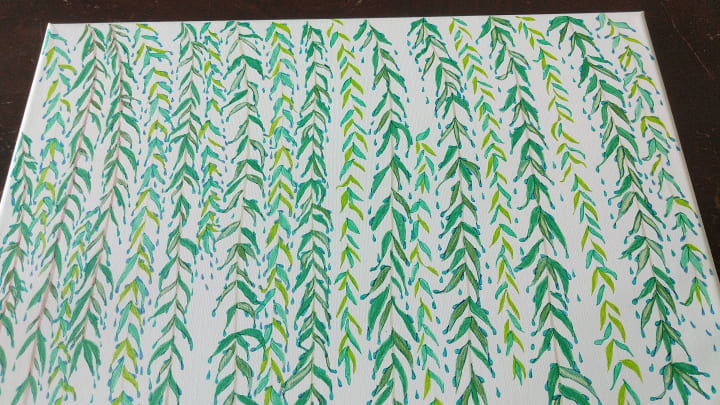
I hadn’t written poems for most of my high school senior year because I had been super busy. I studied poetic devices in greater depth in AP English literature and wanted to play with alliteration symbolizing wind. I envisioned a woman who asks the weeping willow tree about WW2 European battles. I wrote the poem "Weeping Willow" but hadn't illustrated anything until Spring 2021--a few willow branches with raindrops.

Further Inspiration

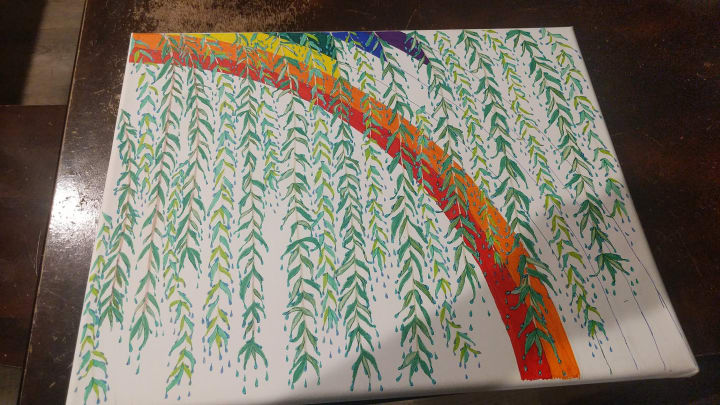
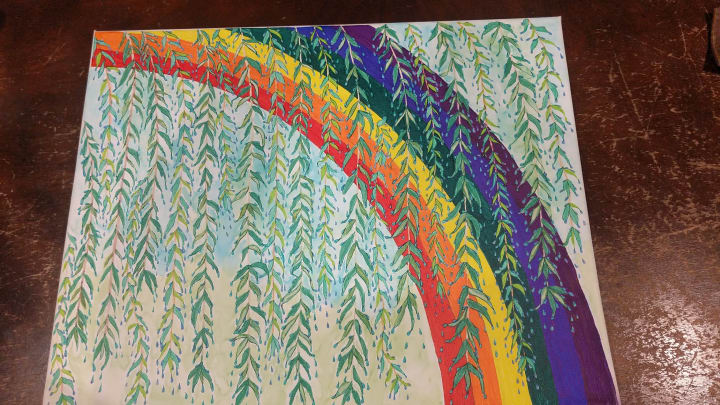
After two relatives passed away this summer, my brother wanted to create paintings about life and the afterlife to give to the children. My brother asked if I would do some of the artwork. Since I had been dabbling with coloring/drawing with markers for eight months, I thought I'd try my hand with markers. A mental vision of willow branches as a veil, rain as tears, and a rainbow of hope emerged from my earlier idea.

Drawing branches Photo by Author

The Branches and Rain

I started with some branches using Crayola's "Colors of the World" markers. On my first three branches, I alternated green leaves with a Sharpie marker and a Papermate marker. The Papermate green marker rubbed off on my right hand, so I kept wiping it off. I used a random brown marker to darken the connection of the leaves and the branch. It looked wrong, so I tried blending it with a light skin tone Crayola marker. The branches turned out thicker than I wanted, but it was now permanent. I removed the random marker from my art markers.

Using the light skin tone marker, I drew a line through the leaves too causing the Papermate marker ink to blend with the Crayola marker ink. I felt a little concerned. However, when I viewed the dried product the next morning, I liked the bleeding effect and the paler tone. For some of the leaves, I added green in again. That green turned out darker.

With each branch, I outlined the leaves then filled them in. I ensured each marker stroke followed the outline's direction. Next, I shaded with dark green lines. I outlined the raindrops then filled them in with ultra-fine point aquamarine or light blue markers. I first drew a circle of white as my highlight to draw around. About half the time, the white spot stayed. On the aquamarine drops, I shaded them with light blue. On the light blue drops, I shaded them with light gray. Next, I shaded all the raindrops with royal blue. Finally, I darkened the branch and drew a line through the middle of the leaves with a Color of the World marker.

Washing Off Marker

While drawing the final branches, my toddler squiggled near the upper right corner. The marker was washable, so I hoped a wet rag could take it off. It did! I wiped off other smudges too. However, this doesn't work on the Sharpie markers or regular paper that soaks in ink.

The Rainbow

I felt nervous about drawing the rainbow arc because I had no circle big enough to trace the lines. My brother had shared with me how to draw circles when he showed me his first painting. He used a string with a pencil attached to the end. Hold the string still on one end while drawing the circumference. This video illustrates it in the last example, but I wouldn't use a pin.

Instead of a pin, my husband held the string on the bottom left corner while I drew the first arc. On the second arc, I noticed the arc had shifted. My husband said I needed to keep the pencil in the same position. I redrew the second arc an inch apart. I repeated the process solo adding an inch of string for the next arc. I felt so proud that I had drawn such a clean arc.

Filling in the rainbow, I had difficulty choosing hues because I only had bold hues in my fine point marker inventory. I would run out of ink using the muted ultra-fine point markers. I chose bold colors anyway. First, I traced the pencil line and branches with the ultra-fine markers in each color. Second, I filled in with the fine point markers while keeping my lines arched. Finally, I applied darker shades of green and blue to the leaves and raindrops.

The Background

How would I fill such a large background space only using markers and not run out of ink? I pondered and concluded I could smudge the water-based markers. I bought small sponge paintbrushes at Hobby Lobby.

First, I squiggled blue or green between the leaves. Second, I dipped the sponge brush in water and squeezed out excess water. Third, I used the sponge to smudge the marker. Some of the leaf ink smudged too. Fourth, I patted the excess water off the canvas with a paper towel. Fifth, I rinsed out the brush between smudges.

Finally, I outlined the leaves and raindrops that faded into the background, especially the leaves that had bled. I kept thinking the art piece needed more, but I told myself it was time to be done. I let the canvas dry overnight and I felt pleased with the smudged background in the morning.

Still, the temptation loomed to shade more. But I let the urge go. The piece was good enough.

The Symbolism

We all have struggles when we can't see through the metaphorical veil of tears. But there is a promise, God's promise, at the end of the storm. A rainbow will appear to remind us of the promise of better days. We can have hope during our painful times. We can find the color amid the gray.

There is hope.

August 30, 2021

It's a Blessing to Be a Burden

 In my downward spiral, I felt I was only a burden. But I learned differently.

Photo by Sung Jin Cho on Unsplash

At some point, most of us feel like we are a burden to others. When we struggle mentally, emotionally, or physically, we may feel like a burden because we require additional care. We cannot fulfill all of our physical and emotional needs without assistance. It’s oh-so frustrating to rely on others for our basic needs. This summer I struggled with additional anxiety and feeling like a burden too.

My Experience of Feeling Like a Burden

In the spring, I started medication to help me manage my weight like many other individuals. One prescribed medication was a stimulant that could exacerbate my bipolar and anxiety. At first, I took a small dose of the stimulant and only experienced some anxiety as a side effect. My weight and blood pressure went down. My doctor said I could experiment with a larger dose. I varied between a full dose and half-dose to find a balance, yet my anxiety still increased.

Some paranoia appeared. I worried certain friends had abandoned me because some hadn’t responded to my messages. I felt like I was too much of a burden to respond to. Logically, I knew they were busy, but emotionally, I felt they had abandoned me. On the other hand, I felt like such a flake because I canceled on two other friends because I was tired. I tried to push through the paranoia and anxiety because I had results with physically feeling better.

On Father’s Day weekend, I took the stimulant too late in the day and slept poorly. On Monday, I was switching the laundry over when my husband suddenly announced he had to go into the office because of our boys’ loudness. My sleep-deprived brain flipped. I pleaded to my husband I needed a nap. At first, I cried. Then my brain spiraled down to the thought I was a burden to my husband; therefore, I must not exist. I self-harmed and my husband restrained me. I still struggled because he still might have gone to the office. After all, the boys are usually loud. My husband continued working from home. I tried napping, but I was too jittery from the medication. I reasoned no one loved me, God hated me, and I was a burden to my husband. Part of me knew my thinking was very skewed, yet the emotional pain and mental fog prevented reason. 

I slipped away from the house to disappear. I shut off my phone so my husband couldn’t locate or contact me. God had abandoned me. No one was looking for me. 

I kept hearing a boy yell “Mom!” I turned around on the path and no one appeared.

At the end of the trail, a young woman said “hi” to me. Maybe the universe cared about me, but then I could be wrong. No one had come to rescue me, unlike other times people had come to my rescue. I kept walking until I felt impressed one of my boys might be hurt looking for me. I returned home still angry and emotionally wrought. I saw my husband in the car. Once home, my husband said he and my oldest had been looking for me and called me. I still said God didn’t care for me because no one had noticed I was gone. No one had contacted me, though I usually contact my mom or siblings. Albeit, I turned off my phone. I cried, yelled, and rocked back and forth for a time. I calmed outwardly, but decided I would be a wooden puppet.

How do you react when you feel like extra weight to someone else?

Counseling Appointment

I debated going to my counselor appointment that evening. I attended. I broke down and my counselor employed some techniques to calm me. I knew this had to be a process she used. I still complained I was a burden and God didn’t care for me. 

She told me everyone is a burden to each other. That’s just a fact of life. 

That thought calmed me. I still felt upset with God. She said maybe God doesn’t exist. I recognized that calming myself mattered more than belief in order for me to stay alive. I could believe it when I had returned to a proper mindset. At the end of the session, I could look at my counselor for a few moments. She asked if I would be okay going home. I said yes.

How do you feel knowing that being a burden is a fact of life?

Aftershock

At home, I tried talking with my husband. I spiraled downward again, but not as severely. I blamed my husband for using me, and so on. I blamed God for someone not reaching out to me. I asked for a priesthood blessing. In the blessing, my husband voiced that angels would help me. I looked and no angels appeared. No one contacted me, but my son hugged me. The dog ignored me, but my husband hovered. No one called or texted me. Where were my angels? I had a test for God. He had to show me angels. Then I thought the angels may be my son and my husband. But they weren’t angels. They were just there to calm me down, so I’d make them regular meals.

Do you discount loved ones' efforts to help you sometimes? Why?

Only an Outside Angel Would Do

My sister texted me late that night. We texted then talked for hours. Then I felt like maybe an angel had come. My husband and son just didn’t count. They are angels, just too familiar angels for me to always recognize.

Do you have angels closer than you think? Do mortals count as angels?

The Paradox of Wanting Attention, But Not Wanting Attention

During the whole downward spiral, I didn’t want to reach out to anyone despite that it is my usual coping skill. Surely, they should know I needed help without my asking. The universe would tell them. I kept waiting. I wanted specific people to reach out in order for my prayer to count as answered.

I thought of posting on Facebook, but I often feel like I am begging for attention, or I am a burden. I struggle with the words of sympathy afterward. I think friends only respond to be nice or feel social pressure to do so. Some comment “Call me. Text me. Anytime.” My brain thinks, “why don’t you just, ‘Call me. Text me. Anytime’ before my plea?” Friends’ sincere reassurance feels futile because it is after my crisis and often only occurs when I draw attention to my distress. Sometimes, I am caught in the paradox of I don’t want attention, but I want it.

On the other hand, I only comment or call when I see someone struggling. I haven’t “been there” daily. I will bear your burden in an emergency yet the daily bearing of that burden feels overwhelming. After all, we have limits on how much we can do.

What reasons stop you from reaching out for help? Have you found a way to balance bearing another’s burdens while practicing self-care?

Follow-up

I made a primary care doctor appointment and stopped taking the stimulant. At the doctor’s office, the doctor told me to stop the medicine and he increased the dosage on another med. Eventually, I stopped all weight management medicine due to side effects. 

Mentally, I can open up about my burden now because it’s solved. My brain is thinking clearer. I still wonder about what to do for the next time when I don’t want to share my messy burden.

Do you make a plan for when you break down?

It’s a Blessing to Be a Burden

I tell myself, it is okay and normal to be a burden. I take on the burden of caring for my family because I love them. They take on my burdens because they love me. My friends and I reciprocate sharing our burdens and triumphs. Sometimes we have the strength to lift another. Other times we need someone to lift us. I hope many of us have the support system to bear one another’s burdens.

For all of our independence, we are an interdependent species. We depend on our parents or guardians as children. As adolescents, we depend more on ourselves and our peer group. As adults, we become as independent as our circumstances allow, yet we still need to rely on each other emotionally. In our weak moments, we can remember that we are each other’s angels. And if it helps, we can depend on God too.

August 19, 2021

Lehi High Chemistry Teacher Let Fear Turn into Bullying Some Students

Learning from this teacher’s mistakes, how can we channel our fear into positive outcomes?

Via Public Domain Photos

Scrolling through Facebook, a post mentioned chemistry teacher Leah Kinyon’s berating students on the first day of school. I searched through the news and my Facebook feed. Some parents on Facebook understandably called for her to be fired. After school on the first day, Alpine School District put the teacher on administrative leave. In the afternoon, the district announced she is no longer an employee (either fired or resigned).

After watching videos and reading comments, I determined Kinyon acted out of fear. She has let her fear of COVID-19, Trumpism, climate change, and anti-LGBTQIA sentiment turn into secondary anger toward others. Her anger manifested as intimidation, bullying, and name-calling toward some students and their parents for several years. Some parents and students feel fear from her actions too. In a way, Kinyon’s actions and the student’s actions represent how we all react to fear.

How can we address these fears in positive ways?

Summary

  • Address fear of the pandemic to civil advocacy of your beliefs
  • Apply the scientific method to parents’ beliefs
  • Understand the fear LGBTQIA and their families face, and the fear on the other side. Understand that we can disagree agreeably about LGBTQIA issues and achieve a compromise of “fairness for all.”
  • Recognize free will creates chaos in a democracy
  • Address abuse with the offender and then authorities kindly and privately
  • Strive to love those outside your circle

Coping with the Pandemic

Many of us fear the effects of COVID-19 and government policies, which fear may manifest as anger or despair. For Kinyon, she fears unvaccinated students passing the COVID variants to her and her family. She understands the suffering it has caused and feels frustrated others aren’t doing their part, just as we all feel about our “side”. 

In our fear, like Kinyon’s, we sometimes place blame on human “spreaders” for the suffering and death caused by the Covid-19 virus. We hate that we can’t control the virus because it isn’t a flesh and blood enemy to conquer. Instead, we dehumanize anyone not following our rules into the virus to retain our false sense of control. After all, we have some ability to control people. Yet we balk when others resent or defy our control over their free will. We justify banning free will under the banner of “right to life.” We fail to see that suffering or dying from the virus is a natural cause. No human deprived someone of their right to life. Nature did.

We can acknowledge the loss of control, to find what is within our individual control, such as personal hygiene and vaccination. We can share our experiences to encourage others to do the same. For example, Kinyon could be a compassionate advocate for the vaccine. She congratulated one student on the vaccine. Why not encourage, instead of shaming, others to vaccinate too?

Instead of turning to anger or despair, we can turn our fear into action, hope, and courage. Hope that the vaccine offers better protection. Hope that the virus is rarely fatal. Hope that we can adjust and thrive despite a virus. Courage to serve others in time of need. Courage to wear a mask, or not to wear a mask. Courage to maintain and encourage civility. 

What positive emotions do you turn your fear into?

Examining Parents Opinions VS Calling for Rebellion

Kinyon drew on teenagers’ desire to question or rebel against what their parents believe. She stated, “My parents were freakin’ dumb!” and that her world opened up after she stopped believing them. She admonished students to follow suit. This statement shows she has partially stayed in a rebellious mindset. Instead, this science teacher could teach students to apply the scientific method, to rigorously examine their parents’ political and scientific beliefs. Then let students form their own conclusions from presented facts, so they may adopt, adapt, or reject their parents’ beliefs. In this way, Kinyon could have promoted healthy independence.

Have you changed your childhood beliefs? Why?

Caring for LGBTQIA Individuals and Others

Bullying and shunning LGBTQIA individuals happen in Utah despite the urging of political and spiritual leaders to love them. According to the 2019 SHARP survey, LGB students experienced about 30% more suicidal ideation than heterosexual students. During my high school years, two classmates expressed their fear negatively that suicide or bestiality was better than being homosexual. Thus, when I felt same-sex attraction as a junior, I panicked. These attitudes, the weaponization of traditional marriage, and a subculture of perfectionism contribute to the LGBTQ suicidal ideation in Utah.

So I get why Kinyon fears for the LGBTQIA students as a Gay-Straight Alliance mentor. She wants to help them feel accepted and loved. However, her fearful approach backfires because she is excluding those who disagree with her (evidenced by “Get out!” in the video). Her exclusive approach alienates those who disagree on LGBTQ issues, instead of inviting them to the discussion where persuasion usually happens. Maybe on her better days, she shows kindness to all students when she sets aside politics.

How can we show love for both LGBTQIA individuals and others? 

Understand Free Will is Chaotic

Politics in a democracy center around free will and persuasion, thus multitudinous viewpoints. The hope is to argue the points kindly, listen to others, adjust positions, and hopefully find solutions fair for everyone. This process appears contentious and chaotic at times when everyone can voice their opinion. Why other countries consider Americans crazy! We will step on each other’s toes. We will offend each other (there is no right to not be offended). What one person does will affect another person. Yet that doesn’t mean someone has always violated another’s free will when it is a natural consequence.

We circumvent the free exchange of ideas when we engage in name-calling, shaming, shunning, or any other method to control another. Because Kinyon fears the influence of Trump and his supporters in the US, she intimidated students with Trumpist views to shut down their speech. This type of attitude on any side of the debate hurts the democratic process.

Kinyon also allowed her burnout and students’ comments to fester her. Understandably, she expressed her frustration, but in the wrong place and time. She probably needs mental rest, like the rest of us.

What do you do to rejuvenate your mind before a difficult discussion?

Overcome Fear to Report Bullying and Abuse

According to parents and students on my Facebook feed, Leah Kinney has acted similarly for eight years. Comments implied students had reported her behavior before. Maybe she received discipline. If she did, it failed to correct the mistakes. Sadly, it took a video to social media to initiate correction. Eric Moutsos revealed Kinyon’s name, workplace, and appearance, which publicly shamed her whether Moutsos intended to or not. Moutsos could have withheld identifying details and blurred her face in the video to let the content speak for itself.

The victims, or students, in Kinney’s case, feel intimidated because the teacher has power over them. I understand that fear as a student. In fifth grade, Mr. L. told D.S., “Damn you to hell” and threatened to paddle us with “Big Bertha” for disobedience. I circulated a classroom petition for him to stop swearing (really verbal abuse). Mr. L. justified to weepy me that he only used biblical words. I directed my fear into action to rectify a problem. Yet I didn’t know to report the verbal abuse to the principal, or even higher.

In my experience schools create an insular space where others fear to report harassment and bullying because of indifferent administrators. For example, I experienced retaliation when I reported workplace harassment as a school substitute. I privately addressed my concerns to the offender, then the school administration yet all justified her badgering. Days later, I received a notice that the substitute agency banned me from subbing at that school due to my “contentious and unprofessional” behavior. Despite my suicidality upon receiving the news, I engaged that fear to report to the district’s human resources department and the substitute agency’s local representative. HR and the representative concluded I could sub the next year at that school, and they would address the teacher’s behavior confidentially. I discovered the agency’s policy was to ban subs at schools whenever the faculty reported issues. In other words, retaliation against subs is a de facto policy.

Those reporting infractions show courage for their actions because of the potential fallout. Yet it matters how and why they report too. Reporting abuse needs to make an effort to correct — not punish — the offender and support the victim. In our society, some desire to destroy and avenge the offender. Both sides deserve love.

What happened when you blew the whistle? Why did you do it?

Love Your Enemies

Kinyon and most of us easily love those who show loyalty and have similar beliefs. We enjoy it when someone aligns their free will with ours. We may create a “tribe” of loyal friends that eventually excludes others. When someone threatens a friend, we defend our tribe, in turn attacking another “tribe.” Hurt feelings may fester into enmity. Thus, we need to remove our mental barriers and expand our circle to those with different viewpoints. And to those who hurt us too within certain boundaries.

April 03, 2021

Poem: Noon Day Sun


He hangs by nails

Above rocks of skull

The noon sun fails

Black clouds overfull


Three hours of dark

Three hours of pain

Three hours no spark

Three hours dark reigns


The guttural cry

The final plea

His breaths die

His Spirit rests free


Rocks slash ajar

Graves yield their saints

The earth shudders

A soldier utters:


“Truly, this was the Son of God”


Behind hewn rock,

His body stays

Earthen waves shock

Lightning strikes blaze


Two angels declare:

“He is gone; He is risen”

Women search elsewhere

For He fled death’s prison


Brighter than noon day sun

He parts the clouds

He blesses one by one

His love enshrouds


Truly He is the Son of God